
'In the January-August period, the share of hatchback in the overall PV industry sales was about 22.4 per cent. In the September-October period, the share of hatchbacks has come down to 20.4 per cent. In just October, their share was just 20 per cent. This is simple wholesale data from industry body SIAM.'

Among the Sensex constituents, Eternal, Tata Steel, Kotak Mahindra Bank, UltraTech Cement, Maruti Suzuki India, Sun Pharmaceuticals, Tech Mahindra, HDFC Bank, Tata Motors Passenger Vehicles, Infosys, Trent, Mahindra & Mahindra, Reliance Industries and HCL Technologies were the gainers. However, Asian Paints, Bharti Airtel, Bajaj Finance, PowerGrid, Axis Bank, ICICI Bank and Titan were among the laggards.
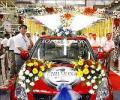
Move could be aimed at integrating operations with Indian subsidiary.

"The Manesar plant remains captive in the hands of workers. There is no production possible there. Due to the impact of components from SPIL, production at Gurgaon will be even lower compared to yesterday," a Maruti Suzuki India spokesperson said.
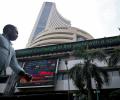
From the Sensex pack, Asian Paints, ICICI Bank, PowerGrid, Larsen & Toubro, Bajaj Finserv, Bharti Airtel, Sun Pharmaceuticals, Maruti Suzuki India, Axis Bank, UltraTech Cement and HCL Technologies were the only gainers. On the other hand, Eternal, Tata Motors' commercial vehicles arm, Mahindra & Mahindra, Tata Steel, Bharat Electronics Ltd, Tata Motors Passenger Vehicles, Trent, Tata Consultancy Services, Hindustan Unilever, and Infosys were among the laggards.

The country's largest passenger car manufacturer Maruti Suzuki India Ltd is planning to hike prices on rise in input costs.The company last raised prices in January 2009.
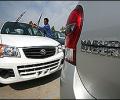
The department had also said it would initiate action to derecognise the unions of SPIL and SMIPL.

The initial public offer of Hyundai Motor India Ltd, the Indian arm of South Korean automaker Hyundai, received an 18 per cent subscription on the first day of bidding on Tuesday. The Rs 27,870 crore initial share sale received bids for 1,77,89,457 shares against 9,97,69,810 shares on offer, as per NSE data. The IPO received over 9 lakh applications on the first day.

The auto major likely to start work for phase one of its Gujarat project within next three months.

After rolling out five compressed natural gas models last year, India's largest passenger car maker, Maruti Suzuki India Ltd, is mulling a CNG platform for all its makes.
Under a new industrial relations deal, the worker's basic right to a living wage and decent working conditions, as well as the right of association and collective bargaining, must be respected and made effective.
The company has proposed to launch the 'made-in-India' car in the next three years. Given its nascent engineering strength, the Indian auto co is looking at existing platforms. The company will, therefore, save a fortune by not opting for a completely new car platform. Generally, the cost of developing a new platform constitutes a substantial part of the expenditure incurred on a new car's production.

Maruti Suzuki India (MSI) on Thursday said its new manufacturing facility in Haryana, the company's third in the state, would reach peak production capacity of 10 lakh units per annum in the next eight years entailing a total investment of Rs 18,000 crore. The new facility, which would come at a 800-acre site at IMT Kharkhoda in Sonipat district, will entail total investment of Rs 11,000 crore in the first phase with a production capacity of 2.5 lakh units per annum. The first set of vehicles are expected to roll out from the facility in 2025.

Among the Sensex constituents, Asian Paints, Tech Mahindra, HCL Technologies, Tata Steel, Maruti Suzuki India, Sun Pharmaceuticals, Tata Consultancy Services, ICICI Bank, Bajaj Finance, UltraTech Cement, Mahindra & Mahindra and Tata Motors Passenger Vehicles were the laggards. However, Eternal, Titan, Adani Ports, Bharat Electronics Ltd, State Bank of India, Bajaj Finserv, NTPC and Bharti Airtel were among the gainers.
After a strong opening, shares of the car-maker further zoomed 9.37 per cent to Rs 1,899.90 -- its 52-week high on the BSE.

Car exports from India have reached the levels of around six lakh units annually.

Labour Minister Shiv Charan Lal Sharma visited Gurgaon on Wednesday to meet senior department officials to decide on the likely course of negotiations.
India's largest car manufacturer Maruti Suzuki India Ltd has resumed its small car exports to Europe after four years and hopes to export about 150,000 cars in the 2010-11 fiscal, a top company official said here on Saturday.
The Amaze, Honda's first diesel car in India, has seen several buyers line up for test drives and dealers struggling to meet increasing demand.

For a contiguous plot, the company may need to pay almost three times more for 40 acres at Hansalpur.

The company added that the employees have offered to donate a day's salary for the cause.

In April, MSI had recalled 1,03,311 units of its popular models -- Ertiga, Swift and DZire -- manufactured between November 12, 2013 and February 4, 2014 to replace faulty fuel filler neck.

Speaking at the forum, Suzuki Motor Corporation (SMC) representative director and president Toshihiro Suzuki said, "Suzuki's future mission is to achieve carbon neutrality with small cars. "We will continue active investment in India to realise Self-reliant India (Atma-nirbhar Bharat)." Under the MoU, the company's wholly-owned arm Suzuki Motor Gujarat Pvt Ltd (SMG) will invest Rs 7,300 crore for the construction of a plant for BEV batteries at a land neighboring to SMG's existing plant by 2026.

The initial public offer of Hyundai Motor India Ltd, the Indian arm of South Korean automaker Hyundai, got subscribed 2.37 times on the third day of the bidding on Thursday, helped by institutional buyers. This is the largest IPO in the country, surpassing LIC's initial share sale of Rs 21,000 crore. The Rs 27,870 crore initial share sale got bids for 23,63,26,937 shares against 9,97,69,810 shares on offer, translating into 2.37 times subscription, as per NSE data.

Leading passenger vehicle maker Maruti Suzuki on Saturday reported marginal growth while Hyundai and Tata Motors posted a decline in their sales in February as a slowdown in the market continued with demand remaining muted. On the other hand, Mahindra & Mahindra and Toyota Kirloskar Motor posted double-digit growth riding on their SUV and MPV models.
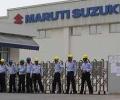
Hit by recurrent labour unrest at its Manesar unit in Haryana, Maruti Suzuki India Ltd (MSIL) on Thursday said the company would introspect on whether an affiliated union with a pro-business approach and mature leadership would benefit the company.
Maruti has rolled out the millionth unit of Alto, since its launch in Sept 2000.
Will sign agreement with vendors to make sure indigenisation takes place within given timeframe.

Indian passenger vehicles market registered record wholesales of 43 lakh units in 2024, with companies like market leader Maruti Suzuki, Hyundai, Tata Motors, Toyota Kirloskar Motor, and Kia posting their best-ever annual domestic sales. The continued growth of SUVs, along with rural markets playing a key role in driving up car sales, helped the industry better the previous best of nearly 41.1 lakh units posted in 2023.

Under the campaign --'Beat The Heat', the company will also offer free top wash, TrueValue evaluation and exchange.
Khattar's place will be taken by Shinzo Nakanishi, who is currently the chairman of MSIL. R C Bhargava, who is a director, has been named the new chairman.
Some economists have said the industry's woes have shown signs of bottoming out.
The company's best selling hatch Alto would come at a discount of Rs 24,500, while Wagon-R petrol and LPG would come cheaper by Rs 45,000 and Rs 24,500 respectively. A discount of Rs 48,000 is being offered on Zen Estilo. The discount being offered across various models also includes finance payouts and exchange bonus apart from the customer offer.
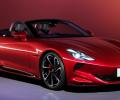
Maruti Suzuki, Tata Motors, Mahindra & Mahindra, Hyundai and MG Motors are gearing up to introduce EVs in India.
Going all out to market the all new Alto 800, pricing the base variant of the new car lower than the outgoing model, Maruti Suzuki India Ltd (MSIL), today said it will start exporting the car from Gujarat's Mundra port from December this year. The first export market is likely to be Chile in South America.

Hyundai Motor India Ltd, the Indian arm of South Korean automaker Hyundai, has received capital markets regulator Sebi's approval to float an initial public offering (IPO), people familiar with the development said on Wednesday. This development marks a significant milestone for the Indian industry, as it is the first automaker initial share-sale in over two decades, following Japanese automaker Maruti Suzuki's listing in 2003.

MSIL, India's biggest car maker, said it was in advanced talks with Fiat to ink a diesel engine sourcing contract that would allow it to rapidly increase diesel model supplies into the market.

Hyundai Motor India and Honda Cars India on Wednesday joined the list of automakers planning to hike prices of vehicles from April, second time this year, to partially offset the impact of rising input costs and higher operational expenses. In a statement Hyundai Motor India Ltd (HMIL) said it will hike prices of its vehicles by up to 3 per cent effective in April 2025.

Hyundai Motor India Ltd has become the country's fifth most valuable auto firm by market valuation in its debut trade on Tuesday. Shares of Hyundai Motor India Ltd, the Indian arm of South Korean automaker Hyundai, listed at Rs 1,931, reflecting a decline of 1.47 per cent against the issue price of Rs 1,960 on the BSE earlier in the day. The stock slumped 7.80 per cent to Rs 1,807.05 during the day and finally ended at Rs 1,820.40 apiece, down 7.12 per cent.
